I've been pouring my heart out on the internet in some capacity for the better part of a decade. I like to think of it as leaving little breadcrumbs of who I was all over the place, a lesson in modern archaeology. Sometimes I pick up those breadcrumb trails and excavate at the crumbling ruins of my old blogs, reading snippets and remnants of the person I once was. This poem is a little snippet I found on an old blog that still spoke to me.
Tuesday, March 12, 2013
My name is Courtney Gold and I have eyes the color of dirty icicles hanging from the roof and gloomy mornings that you can't get out of bed. They used to be the cliched color of ocean depths, used to be a color that caused that girl in my sixth grade class to say "your eyes are like two shining swimming pools and I want to jump in" but like everything else now that's faded faded faded
I remember the first time I bore witness to the darkness of the human spirit in first grade when my best friend spat on me because a girl promised her tickets to Disney World if she got rid of me. I don't think I ever saw her again.
I used to stand out and feel the wind push against me so urgently like it had somewhere to go where are you going Mr. Wind can you take me along I want to play with you
I remember stained glass windows with the sun setting them ablaze and wishing to be so vibrant, to be set ablaze
Remember little flowers with dainty white petals and wishing and wishing to be so little, so little that I could slip through the cracks and never be seen
Remember
Remember
r
e
m
e
m
b
e
r
My name is Courtney Gold and I have something to say, I just haven't figured it out yet.

Friday, May 8, 2020

My Library: The Books that Have Shaped My Life, For Better or Worse
What do you use as a frame of reference for the stages in your life? Do you categorize your memories by year or grade school level? Maybe the company you kept: phases of boyfriends and girlfriends? What about by the books you read that changed you? I think the books we read become part of us and shape who we are and hope to be. Books and words are an integral part of the context of my life; I like looking at the books I've read that have stayed with me in the context of everything happening in my world, like chapters in my life. These are some of those chapters.
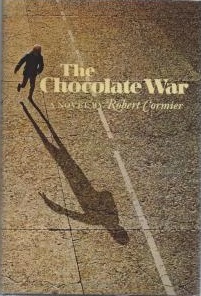




The Chocolate War by Robert Cormier
I read this book in 4th grade -- probably too young, in hindsight, but the best reads of my life were the books I snuck that I was too young to read. It's the story of a kid struggling against conformity at his Catholic school, whose refusal to sell chocolates for the school ends with him (spoilers,but not really because the book was published in 1974 and you've had plenty of time to read it) getting beaten nearly to death as the entire school watches, doing nothing to intervene. The headmaster actually thanks the person who orchestrated the beating. That's it, that's the ending. Throughout the story, the main character had been motivated by anonymous graffiti that asked "Do I dare disturb the universe?" After almost dying due to disturbing the private school social order, he decides... that he daren't.
At an age where the majority of stories fell flat to me with cloyingly sweet happy endings, reading my first book without any semblance of a happy ending was stark and refreshing. Listen, I was deeply depressed from a young age and the bleakness of this story spoke to me. At the end of the story, nobody was better off for it and the main character that you're supposed to be rooting for didn't accomplish anything, but almost died for it anyway. After reading this book as a kid, every short story and novel idea I wrote had an ending ranging from bittersweet to downright miserable. I still wonder if I dare disturb the universe, but I think we probably know the answer.

The Chocolate War by Robert Cormier
I read this book in 4th grade -- probably too young, in hindsight, but the best reads of my life were the books I snuck that I was too young to read. It's the story of a kid struggling against conformity at his Catholic school, whose refusal to sell chocolates for the school ends with him (spoilers,
At an age where the majority of stories fell flat to me with cloyingly sweet happy endings, reading my first book without any semblance of a happy ending was stark and refreshing. Listen, I was deeply depressed from a young age and the bleakness of this story spoke to me. At the end of the story, nobody was better off for it and the main character that you're supposed to be rooting for didn't accomplish anything, but almost died for it anyway. After reading this book as a kid, every short story and novel idea I wrote had an ending ranging from bittersweet to downright miserable. I still wonder if I dare disturb the universe, but I think we probably know the answer.
Wicked by Gregory Maguire
We all know the story of The Wizard of Oz, and most of us know the story of Wicked the musical, but not as many people have read the book the musical was loosely based on -- that is in itself loosely based on Frank Baum's original. In this book, Maguire defines the retold fairytale genre for me. He complicated, grounds, and elevates the story of the Wicked Witch (here given a real name at last: Elphaba) with politics and lore, allegories and philosophy. The book asks if good and evil exist, and if so, are any of us born destined for one or the other? Elphaba's pain and grief are visceral and human, her isolation and undoing understandable. It makes me think about legacy, in the way we memorialize people into neat boxes that are easy to digest, typecast as either the Good or Wicked Witches of our stories. What will be my legacy?
I read this one for the first time also in elementary school, also inappropriate, also some pretty heavy topics for pre-pubescent me. This was my favorite book for the better part of a decade until I realized I had too many books that were special to me to have a true favorite, but it will always be my first true love.
Mr. Penumbra's 24-Hour Bookstore by Robin Sloan
Finally, a lighter read! This was a book club pick, and was one of my favorite books to read in the more recent decade of my life. That is to say, most of the books on this list I read when I was young and needed the escape of a good book that I would devour in hours. When I was little, weekends with my dad would mean a trip to Barnes & Noble where he would sit in the cafe reading car magazines while I picked out two books: one to speedread while I was still in the bookstore hidden in the stacks, and a different one I would emerge with a couple hours later for him to buy for me to read at home. The very best of times. After high school, reading for pleasure took a back seat to literally everything else and even when I did read, I couldn't immerse myself and fall in love with new books the way I once did. Enter: adult book club.
The story takes place in a bookstore mired in mystery and urban fantasy. The story functions like a crudites platter: your reaction to the veggies usually range from 'okay' to 'man I love cucumbers', but ultimately they just serve the function of shoveling dip into your mouth. The dip in the case of this book is the description of the bookstore and the books themselves: lush, rich, warm, inviting, engaging, BOOKS. I thought the story was fun and unexpected, but beyond that the reason I really really love this book is that it re-ignited my love of reading. After I read this for book club, I quickly read through several books that had been waiting on my shelf for years -- almost like the good ol' days.
The story takes place in a bookstore mired in mystery and urban fantasy. The story functions like a crudites platter: your reaction to the veggies usually range from 'okay' to 'man I love cucumbers', but ultimately they just serve the function of shoveling dip into your mouth. The dip in the case of this book is the description of the bookstore and the books themselves: lush, rich, warm, inviting, engaging, BOOKS. I thought the story was fun and unexpected, but beyond that the reason I really really love this book is that it re-ignited my love of reading. After I read this for book club, I quickly read through several books that had been waiting on my shelf for years -- almost like the good ol' days.
Flipped by Wendelin Van Draanen
This was another elementary school read, a coming of age split-narrative between a girl and boy growing up as neighbors and developing crushes on each other, told from both perspectives in turn. The girl at the heart of the book, Julie, is obnoxiously spirited and big-hearted in her love for things other people take for granted, like a giant gnarled sycamore tree that she climbs daily until it gets chopped down, her protest unsupported by any friends or family. I cried my heart out about that sycamore tree getting cut down, hoping that it wouldn't represent her spirit being cut down. Her counterpart Bryce is indifferent and passive, bothered by Julie's refusal to tone down her passion. His grandfather tried to get Bryce to appreciate Julie with this paint analogy: “Some of us get dipped in flat, some in satin, some in gloss...." He turned to me. "But every once in a while, you find someone who's iridescent, and when you do, nothing will ever compare.”
This book will always have a special place in my heart and on my shelf. My older sister Ashley died when I was 10. She was away at college and was the coolest person in the world to me, with an infectious laugh and a mischievous twinkle in her eye that made you feel like you were always in on some silent joke. She was so alive and iridescent and I wanted to be like her, but I was afraid that I was made of different stuff, dipped in flat paint so to speak. I wanted to read this passage and speak about it at her funeral service, but I had a panic attack and was taken to the hospital instead so I never had my chance.
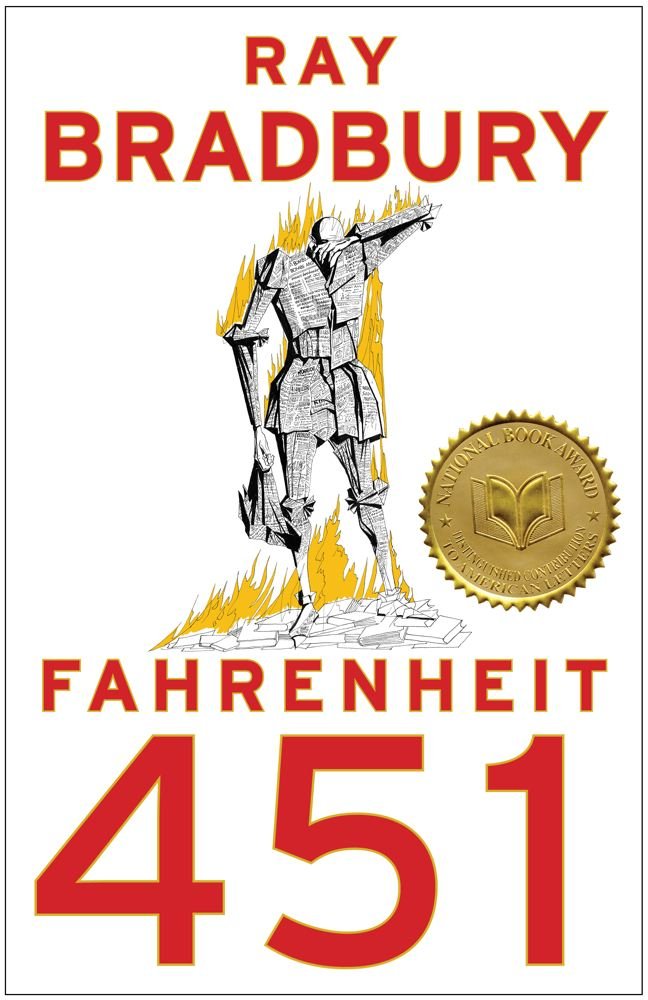
Fahrenheit 451 by Ray Bradbury
In this classic dystopian, reading is outlawed and books are seen as incendiary propaganda. Firefighters, rather than put out fires, symbolically fight the power of illicit literature by setting fires. The main character is a firefighter who is shocked loose from complacency by a series of violent events, including the suicide of a woman who would rather set herself on fire than get rid of her book collection. I read this book for 7th grade English class and quickly pronounced it my favorite book. Even more influential to me than the book itself was my teacher Ms. Candy, who also acted as principal at the tiny, bohemian, secular private school I was sent to for the year. She had auburn hair cut into a precise bob with the coolest thick streak of silver framing her face, and piercing yet warm Minerva McGonagall eyes that drilled into you "Think deeper!" She pushed us to read things that made us uncomfortable and to sit with that discomfort.
The thought of destroying all written knowledge is depressing. In college, I studied Sociology and fell in love with the immense body of literature of social research and sociological theory, densely woven together by webs of citations and references to other research. Knowledge is something we've constructed through generations of scholars building higher and higher using the scaffolding of previous scholars. Think of the destruction of the Library of Alexandria, which likely set society back thousands of years because of the knowledge lost. Hopefully this cautionary tale is enough to prevent history from repeating itself.
The Spirit Catches You and You Fall Down: A Hmong Child, Her American Doctors, and the Collision of Two Cultures by Anne Fadiman
I read this book for my cultural anthropology class in college, which tells the true story about a Hmong family of refugees clashing with the American healthcare system in California about the best way to take care of their infant daughter Lia Lee who suffers from epilepsy. Lia's family understood her condition through the lens of their Hmong cultural beliefs and that she needed to be treated with spiritual treatments from a shaman, while her doctors understood her condition strictly through the lens of Western medicine. The inability to communicate across these differences (and the literal inability to communicate since the hospitals didn't hire any Hmong interpreters...) resulted in brain death for Lia.
This book really challenged me. From the perspective of someone raised in the Western healthcare system, it's easy to be frustrated at the family who prevented Lia from receiving medicine that might have saved her life. But from their perspective, the doctor's treatments were conversely endangering their child's life. It can't be framed as a case of neglect, because Lia's family loved her so much and cared for her diligently, which is how doctors surmise she survived as long as she did (26 years after her brain death, which is nothing short of miraculous). It's just a tragedy and a cautionary tale of the institution of healthcare failing a whole family. The story was part of the most important lesson I learned in college: the importance of seeing every side of the story with compassion, but not letting people or unjust institutions off the hook, an important chapter in my story of activism in college.
A Million Little Pieces by James Frey
Though there have been deep controversies about how true this "true story" is, at face value it's a great story and one that I read multiple times when I was young. The supposed-to-be autobiographical tale is about James' path from the depths of addition back to sobriety due to one last stint in rehab after nearly dying. The scene at the dentist, where he has to have root canal surgery performed on multiple teeth but isn't allowed anesthesia because of his addiction, has stayed with me as the most disturbing, visceral, painful scene I've ever read. Every time I think on it however briefly, I feel the white hot pain so perfectly like it was my own memory.
I read this book along with stories like It's Kind of a Funny Story (instead of rehab, enter teenage psych ward) when I was going through a dark time as a teenager dealing with anxiety, depression, eating disorders, and really self-destructive impulses. I didn't really put it together at the time, but it was important for me to read about people who went to their deepest dark, rock bottom pits of self hatred and were able to find their way back to something resembling the light. It meant that no matter how much I despised myself at times, there was always a path forward.
The thought of destroying all written knowledge is depressing. In college, I studied Sociology and fell in love with the immense body of literature of social research and sociological theory, densely woven together by webs of citations and references to other research. Knowledge is something we've constructed through generations of scholars building higher and higher using the scaffolding of previous scholars. Think of the destruction of the Library of Alexandria, which likely set society back thousands of years because of the knowledge lost. Hopefully this cautionary tale is enough to prevent history from repeating itself.
The Spirit Catches You and You Fall Down: A Hmong Child, Her American Doctors, and the Collision of Two Cultures by Anne Fadiman
I read this book for my cultural anthropology class in college, which tells the true story about a Hmong family of refugees clashing with the American healthcare system in California about the best way to take care of their infant daughter Lia Lee who suffers from epilepsy. Lia's family understood her condition through the lens of their Hmong cultural beliefs and that she needed to be treated with spiritual treatments from a shaman, while her doctors understood her condition strictly through the lens of Western medicine. The inability to communicate across these differences (and the literal inability to communicate since the hospitals didn't hire any Hmong interpreters...) resulted in brain death for Lia.
This book really challenged me. From the perspective of someone raised in the Western healthcare system, it's easy to be frustrated at the family who prevented Lia from receiving medicine that might have saved her life. But from their perspective, the doctor's treatments were conversely endangering their child's life. It can't be framed as a case of neglect, because Lia's family loved her so much and cared for her diligently, which is how doctors surmise she survived as long as she did (26 years after her brain death, which is nothing short of miraculous). It's just a tragedy and a cautionary tale of the institution of healthcare failing a whole family. The story was part of the most important lesson I learned in college: the importance of seeing every side of the story with compassion, but not letting people or unjust institutions off the hook, an important chapter in my story of activism in college.
A Million Little Pieces by James Frey
Though there have been deep controversies about how true this "true story" is, at face value it's a great story and one that I read multiple times when I was young. The supposed-to-be autobiographical tale is about James' path from the depths of addition back to sobriety due to one last stint in rehab after nearly dying. The scene at the dentist, where he has to have root canal surgery performed on multiple teeth but isn't allowed anesthesia because of his addiction, has stayed with me as the most disturbing, visceral, painful scene I've ever read. Every time I think on it however briefly, I feel the white hot pain so perfectly like it was my own memory.
I read this book along with stories like It's Kind of a Funny Story (instead of rehab, enter teenage psych ward) when I was going through a dark time as a teenager dealing with anxiety, depression, eating disorders, and really self-destructive impulses. I didn't really put it together at the time, but it was important for me to read about people who went to their deepest dark, rock bottom pits of self hatred and were able to find their way back to something resembling the light. It meant that no matter how much I despised myself at times, there was always a path forward.
The Sweet Far Thing; Rebel Angels; A Great and Terrible Beauty (The Gemma Doyle trilogy) by Libba Bray
I love these books so much. I actually picked up Rebel Angels when I was about 12 on one of those aforementioned Barnes & Noble trips and poured through it, and only afterwards realized that I had picked up the second book in a trilogy and dumped myself in a story halfway through being told. I didn't care, I reread it multiple times and then a couple years later picked up the 1st and 3rd installments and read it all through again (I am nearly finished re-reading them again since as I write this blog post we are about a month in to a nationwide lockdown due to the coronavirus epidemic. I'm sure this will be part of an important chapter I look on in the future as well.)
The story is about a bright, headstrong, snarky young woman in late Victorian England coming of age with dark secrets, magical powers, and the whole shebang. Society, fashion, and manners are suffocating and oppressive, but the allure of a secret society and the exhilaration of illusion magic seem like promises of freedom. The heroine alone has the power to open a door to another seemingly idyllic realm where it rains flower petals and you can conjure your greatest desires, but this power is muddied by a violent history of murder and control. One of my favorite discussions in the books is inspired by art teacher Mrs. Moore, with her own dark mistakes and secrets, who discusses the nature of light and dark in a painting, called chiaroscuro by Italian artists, in A Great and Terrible Beauty.
But forgiveness...I'll hold on to that fragile slice of hope and keep it close, remembering that in each of us lie good and bad, light and dark, art and pain, choice and regret, cruelty and sacrifice. We're each our own chiaroscuro, our own bit of illusion fighting to emerge into something solid, something real. We've got to forgive ourselves that. I must remember to forgive myself. Because there's an awful lot of gray to work with. No one can live in the light all the time.
Tell me: what books in your life's library have had the most impact on you?
Tell me: what books in your life's library have had the most impact on you?
Subscribe to:
Posts (Atom)